

green gram (moong dal)
Green gram, also known as moong dal, is one of the important pulse crops grown in Avanigadda. It is mainly cultivated during the rabi and summer seasons after the harvest of paddy. The fertile delta soil, good drainage, and moderate climate make Avanigadda an ideal region for growing green gram. Farmers usually sow the crop between December and January, and it matures within 60 to 70 days, making it a short-duration and profitable crop. Popular varieties like LGG 460, LGG 450, and MGG 295 are grown for their high yield, resistance to pests, and good grain quality. Green gram plays an important role in improving soil fertility, as it fixes nitrogen in the soil, benefiting the next crop, especially paddy. It is also in high demand for household consumption, dal mills, and export. Because of its low input cost, quick returns, and soil-enriching properties, green gram cultivation is a preferred crop among small and medium farmers in the Avanigadda region.
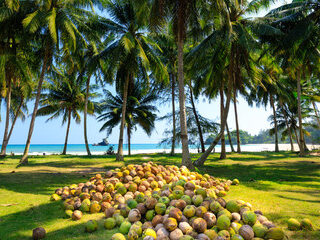
coconut crop
Coconut is another major crop grown in Avanigadda, especially in the coastal and riverbank areas of the Krishna District. The region’s humid climate, fertile delta soil, and abundant groundwater make it ideal for growing coconut trees throughout the year. Farmers in Avanigadda usually grow varieties such as East Coast Tall, Hybrid Dwarf, and Tiptur Tall, which are known for their high yield and quality copra (dried coconut kernel). Coconut trees are commonly planted along field boundaries, canal banks, and around houses, providing both economic value and natural shade. The coconuts from Avanigadda are used for oil extraction, household consumption, and tender coconut water sales. Many small-scale industries in and around the town depend on coconut-based products like coconut oil, coir, and copra. Because of its steady market and long-term yield, coconut cultivation plays a key role in supporting rural livelihoods and maintaining the eco-balance in the Avanigadda region.
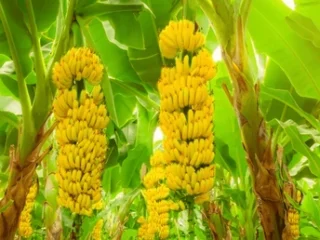
Banana Crop
Banana cultivation is very popular in Avanigadda because of the fertile soil and good irrigation from the Krishna River. Farmers grow different varieties of bananas such as Robusta, Dwarf Cavendish, and Rasthali. The crop gives good yields and provides steady income throughout the year. Banana plantations can be seen widely across the Avanigadda and nearby villages, making it one of the region’s most important commercial crops. The region’s alluvial soil, abundant water supply from the Krishna River, and humid tropical climate make it ideal for banana farming. Farmers generally plant banana suckers between June and August, and the crop is ready for harvest within 10 to 12 months. Commonly grown varieties include Grand Naine (G-9), Robusta, Dwarf Cavendish, and Rasthali. These varieties are preferred for their high yield, large fruit size, and long shelf life. Banana farming in Avanigadda also supports local markets and exports, with produce sent to cities like Vijayawada, Hyderabad, and Chennai. Farmers use drip irrigation and organic manure to maintain soil fertility and improve quality. After harvest, bananas are packed carefully and transported to wholesale markets and processing units. Because of its profitability and steady market demand, banana cultivation plays a key role in the economic growth of Avanigadda’s farming community.