
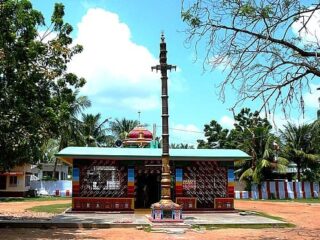
Sri Lankamma Ammavari Temple
Sri Lankamma Ammavari Temple is one of the most revered temples in Avanigadda, Krishna District. The temple is dedicated to Goddess Lankamma, the presiding deity and guardian mother of the region. Locals strongly believe that the goddess protects the coastal belt of Diviseema from natural calamities and blesses devotees with prosperity and well-being. The temple attracts thousands of devotees, especially during festivals and annual jatara (fair), when special rituals and cultural programs are organized. With its deep-rooted traditions, spiritual significance, and vibrant celebrations, the temple stands as a symbol of faith and devotion for the people of Avanigadda and surrounding villages. Lankamma Ammavari Jathara The main festival of the temple. Celebrated once a year on the full moon day (Pournami) in summer. Devotees from Avanigadda and surrounding villages gather in large numbers. Special rituals, cultural programs, and community feasts (annadanam) are organized. The festival is believed to strengthen the protective blessings of the Goddess for the people of Diviseema. Vehicle Pooja Devotees bring their new vehicles (bikes, cars, autos, tractors, etc.) to the temple. A special Vahana Pooja (Vehicle blessing) is performed seeking the goddess’s protection during travel. This has become a popular custom in Avanigadda. Other Occasions Significance: Navaratri is a nine-day festival dedicated to the Divine Feminine (Devi), celebrating her power, protection, and blessings. At Sri Lankamma Ammavari Temple, the festival honors the Goddess Lankamma Ammavari as the guardian deity of the region. Dasara (Vijayadashami) marks the tenth day, symbolizing the victory of good over evil. Rituals & Customs: Daily Poojas & Aartis: Devotees perform special poojas each day, offering flowers, fruits, and coconuts. Aarti is conducted in the morning and evening with traditional lamps. Alankaram (Decoration of the Deity): The idol of the Goddess is beautifully adorned with sarees, jewelry, and flowers. Different themes may be used each day to depict various forms of the Goddess. Cultural Programs: During Navaratri, local communities often organize folk dances, devotional music, and drama performances near the temple. Children and youth participate in Bhajana Mandalis (devotional singing groups). Community Feasts (Annadanam): On major days, free meals (annadanam) are served to devotees and visitors, fostering a sense of community. Vijayadashami Rituals: On the tenth day, special prayers are offered for victory, health, and prosperity. It is also an auspicious day to start new ventures, purchase tools, or vehicles, and many devotees perform Vahana Pooja for newly bought vehicles. Timing & Popularity: Navaratri usually falls in September-October (according to the Hindu lunar calendar). Thousands of devotees visit the temple during these nine days, making it one of the most celebrated festivals in Avanigadda.
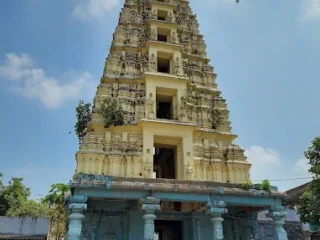
Sri Lakshminarayana Swamy Devastanam
The Pancha Bhavan Narayana Kshetras, Pancha Bhoota Lingas, Pancharamas, and Pancha Lakshmi Narayana Kshetras are renowned in Telugu land. In the Sahyadri Khandam of the Skanda Purana, Sage Vyasa, in the Brahma Vaivarta section, described the greatness of the Pancha Lakshmi Narayana Kshetras. Avanigadda was once the hermitage of Sage Vasishta, the royal preceptor of Lord Sri Rama. Tradition says that Goddess Sita used to listen to discourses on Dharma from Sage Vasishta here. Because of this, the region came to be called Avanijapuram after Sita Devi. The place where Sita stayed during her exile is known as Seethalanka, while the hermitage of Vasishta was referred to as Vasisthemetta. Over time, this area came to be known as Avanigadda. The five sacred Lakshmi Narayana temples located at Nadakuduru, Avanigadda, Nalluru, Rachuru, and Pedamuttevi are collectively known as the Pancha Lakshmi Narayana Kshetras. During the Satavahana period, Avanigadda was a flourishing port town. This region, which adds special significance to Diviseema, has held great importance since ancient times. This temple, originally built nearly a thousand years ago, was reconstructed in 1824. In 1977, during the Diviseema cyclone, the temple’s Dwajasthambam (flagstaff) collapsed, and it was re-consecrated in 1990. The place where the temple is established is also called Lakshmipati Lanka. The present temple gopurams were built by Kulothunga Chola II, the Chola king. Hence, the presiding deity is also revered as Chola Narayana Devara. Statutes Local inscriptions state that it was built by the ruler Kulothunga Chodadev II and made some donations. The temple premises also include the Rajasekhara temple and the Anjaneyaswamy temple. The Lakshminarayana temple is also adorned with a sanctum, an ardhamandapa, a mahamandapa, and decorative sculptures on three sides. There is another temple to the left of the ardhamandapa, a four-legged (goshthi) mandapa in the northeast, surrounded by a rampart, and a seven-story Rajagopuram to the east. There is also a mandapa inside the gopuram. There are many inscriptions that tell the history of this temple. Six Telugu inscriptions dating from the period between 1138–1154 CE are engraved, one on the gadapa of the ardhamandapa, four on the pillars of the gopura, and one on the Kappa rock. CE Two inscriptions dated 1138 contain details of donations made by Muttamanayaka’s daughter Kommama. The third inscription dated 1147 CE contains details of donations made by Gangamarayani’s daughter Chodamba, and the fourth inscription dated 1152 CE contains details of donations made by Medamba’s daughter Noonkama. The details of the fifth inscription are not known as the inscriptions are not clear. However, two inscriptions in the nearby Ganapeshwara temple mention female sculptors for the first time. The Ganapeshwara temple inscription of 1771 CE states that Nagireddy’s son Subbanna installed the Ganapeshwara lingam, and that the lingam was carved by Mallikarjuna of Maguluri and his wife Veeramma’s son Akkabattu. The inscription of 1729 CE also states that Chodaraju had previously installed a Vaishnava idol at the confluence of the rivers, and that Lingabattu’s wife Lingamma, his son Kollabatta, his wife Rudrama, their son Kamakshi, his wife Parvathi, and their sons Mallaya, Nagappa, Sarabhaya, and Veerappa participated in carving it. Diviseema also has the distinction of providing female sculptors Chariot architecture The sculpture carved on both sides of the steps in front of the temple Mahamandapam, which shows the temple being pulled forward like a chariot, is not only found in this region, but also in the entire Telugu land. The horses running in front of the chariot wheel, the riders sitting on the reins and wearing swords and shields, and the stone carved with a lotus in a circle in front of the horses attract the beholders a lot. The servant of the Cholas of Velanati, who ruled from Chandoli in Guntur district, built a temple in the form of a chariot in Diviseema exactly a hundred years before Konark built by the Kalinga Ganga Chakravarti Narasimhadeva, and earned the reputation of building the first chariot temple not only in Telugu land but also in the entire South India. Famous This place is famous for being the place where the temple has the second tallest Galigopuram in Andhra Pradesh, which is a standing form of ancient art in Suvisala Logili. The 99 feet high Galigopuram is a special attraction of this temple. With seven floors and seven kalashalas, this temple gopuram is the tallest after the Galigopuram in Mangalagiri . Many sculptures and works of art on this gopuram, which is coherent and clear, delight the eyes of the devotees. The temple is built in the form of a chariot on a special stone pedestal. This reflects the architectural style of the Chola kings. In this temple, Lord Vishnu appears as an Archavataramurthy and Goddess Lakshmi as a beautiful one. In the sanctum sanctorum, the Dhruvamurthy of Sri Lakshmi Narayana Swamy is displayed in the form of a Salagrama stone with amazing beauty. The Lord appears in the form of Narayana holding Goddess Lakshmi as his wife on his left arm. In the sanctum sanctorum, Goddesses Lakshmi and Narayana are adorned with all kinds of ornaments. He appears in the form of a Makarathorana with silver ornaments, a pair of eyes, a moustache and a crown of thorns. It is said that this Lord was actually installed by Sri Rama. There is a goddess named Rajya Lakshmi. Festivals A wedding ceremony is held for this Swami on Vaisakha Purnima . A festival is held on Mukkoti Ekadashi. Similarly, festivals are held on the occasion of Dussehra festival. Apart from these, one lakh Tulsi Puja is performed for the Swami on Karthika shudda Ekadashi.

Haritha nursing home
Haritha Nursing Home is a well-regarded healthcare facility located in Avanigadda, Krishna District, Andhra Pradesh. Situated near Kotapeta Road, it serves as a primary medical center for the local community and surrounding areas.

green gram (moong dal)
Green gram, also known as moong dal, is one of the important pulse crops grown in Avanigadda. It is mainly cultivated during the rabi and summer seasons after the harvest of paddy. The fertile delta soil, good drainage, and moderate climate make Avanigadda an ideal region for growing green gram. Farmers usually sow the crop between December and January, and it matures within 60 to 70 days, making it a short-duration and profitable crop. Popular varieties like LGG 460, LGG 450, and MGG 295 are grown for their high yield, resistance to pests, and good grain quality. Green gram plays an important role in improving soil fertility, as it fixes nitrogen in the soil, benefiting the next crop, especially paddy. It is also in high demand for household consumption, dal mills, and export. Because of its low input cost, quick returns, and soil-enriching properties, green gram cultivation is a preferred crop among small and medium farmers in the Avanigadda region.
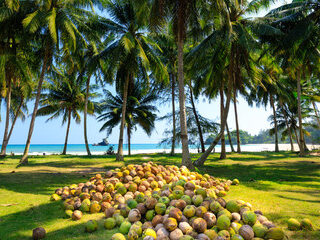
coconut crop
Coconut is another major crop grown in Avanigadda, especially in the coastal and riverbank areas of the Krishna District. The region’s humid climate, fertile delta soil, and abundant groundwater make it ideal for growing coconut trees throughout the year. Farmers in Avanigadda usually grow varieties such as East Coast Tall, Hybrid Dwarf, and Tiptur Tall, which are known for their high yield and quality copra (dried coconut kernel). Coconut trees are commonly planted along field boundaries, canal banks, and around houses, providing both economic value and natural shade. The coconuts from Avanigadda are used for oil extraction, household consumption, and tender coconut water sales. Many small-scale industries in and around the town depend on coconut-based products like coconut oil, coir, and copra. Because of its steady market and long-term yield, coconut cultivation plays a key role in supporting rural livelihoods and maintaining the eco-balance in the Avanigadda region.
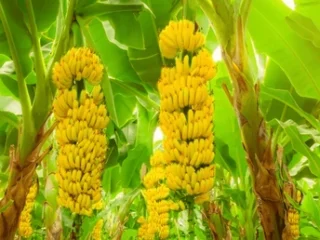
Banana Crop
Banana cultivation is very popular in Avanigadda because of the fertile soil and good irrigation from the Krishna River. Farmers grow different varieties of bananas such as Robusta, Dwarf Cavendish, and Rasthali. The crop gives good yields and provides steady income throughout the year. Banana plantations can be seen widely across the Avanigadda and nearby villages, making it one of the region’s most important commercial crops. The region’s alluvial soil, abundant water supply from the Krishna River, and humid tropical climate make it ideal for banana farming. Farmers generally plant banana suckers between June and August, and the crop is ready for harvest within 10 to 12 months. Commonly grown varieties include Grand Naine (G-9), Robusta, Dwarf Cavendish, and Rasthali. These varieties are preferred for their high yield, large fruit size, and long shelf life. Banana farming in Avanigadda also supports local markets and exports, with produce sent to cities like Vijayawada, Hyderabad, and Chennai. Farmers use drip irrigation and organic manure to maintain soil fertility and improve quality. After harvest, bananas are packed carefully and transported to wholesale markets and processing units. Because of its profitability and steady market demand, banana cultivation plays a key role in the economic growth of Avanigadda’s farming community.